Brussels

We're back in Bonn after another Bosch seminar trip.  Our bags are unpacked, there is food in the fridge again, and it is time for a recap.  We were on the road for two weeks this time, visiting Brussels, Strasbourg, and Paris.

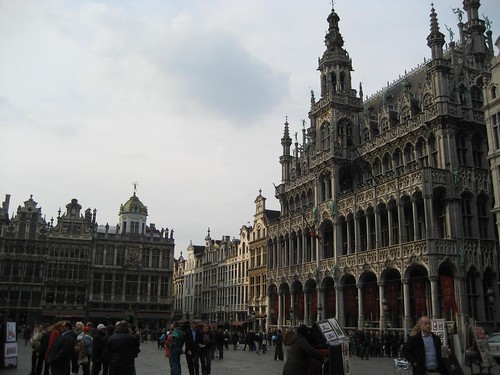
I'd been through Brussels before, but I had never spent spent days there previously.  The city strikes me now as a pleasant mishmash of urban personalities.  Its iconic space is the grand place, lined on all sides by imposing facades, including the gothic town hall, and a good many gold-encrusted guild halls.


Having seen many German cities, the old town in Brussels looks decidedly run down.  The cobblestone streets are so uneven one wonders if anyone is taking care of them; many walls are dirty or crumbling; and a surprising number of storefronts are vacant for a place overrun with tourists.

We like to live here.  The cars smell good. We like to die.  

It tells you something about the locals that their mascot is a statue of a pissing boy, the Manneken Pis.  If the city looks a bit shabby (despite its obvious EU-generated wealth) then too bad.


Manneken Pis is, naturally, reproduced ad nauseam as a tourist knickknack, and is also the inspiration for what a copyright lawyer would call derivative works, such as a statue of a pissing girl, Jeanneke Pis, and signs depicting a pissing dog, which indicate designated dog toilets.


Especially south and a bit east of the city center, one encounters a number of art nouveau buildings. As with the rest of the city, they are frequently dirty and shabby, despite their inherent elegance.   I took myself on a tour, but E. took a guided tour, and the guide pointed out that in fact many of the buildings are in bad shape, and that there are few craftsmen capable of maintaining them properly.  Having seen analogous buildings in Vienna, Paris, and even Chicago, I do have to conclude that Brussels art nouveau is underwhelming.


I realize I am alone in my odd enthusiasm, but one of the really great things about Brussels is that it is the undisputed capital of the French-language comic book (Tintin, Asterix, etc.).  Contributing to the city's funky feel, there are many murals celebrating comic book illustration.  In this one, you look down from an imaginary position in the sky at the place where you are standing, except that where you are really standing is a river (and it would be, except that the rivers have all been chased underground).


The Belgian Comic Strip Center is a museum devoted to comics, particularly of the francophone kind.  It is housed in a building designed by Victor Horta, the best known art nouveau architect of Brussels.


My impression of Brussels from this trip is disjointed.  Some of it is lovely.


Some of it could use a good scrub and some competent urban planning.  And I take it I should keep an eye out for bandits ahead.

Our Star for Oslo


The television offerings in Germany are awful in too many ways to describe. Throughout the year I have been amazed that the channel I watch most consistently is VIVA, a video channel similar to MTV. I don't have the German medical or legal terminology to watch House or Law and Order dubbed, and I have no patience for the dozens of regionally produced (i.e. PBS-style) Stammtisch programs, where people sit around and talk.

This spring I briefly fell under the spell of Deutschland Sucht den Superstar, Germany's version of American Idol (which is amazing in part because I would never, ever waste my time on Idol). In a similar vein but more to the point, I completely succumbed to Unser Star für Oslo (Our Star for Oslo).

The Eurovision Song Contest, for those who don't know, is an annual event televised all across Europe. Established in 1956 as an experiment in simultaneous transmission, the contest has become a European cultural phenomenon. The reason for this, I think, is that it is the only time in the year when everyone in Europe can turn on the television and watch what everyone else is watching.

As Americans, I think we have no idea how tantalizing this premise is. Culture critics complain that since Cronkite and Carson went off the air we no longer have shared mediated experiences. It may be true that we now live in a world with 57 channels and nothing on, but the fact remains that day after day, people in Idaho, Iowa, Alabama, Alaska, Maine, and Michigan all watch exactly the same programs on television. Now imagine a world in which each state speaks its own language, and has its own television networks, and in which there are only two hours a year when people in all 50 states watch the same thing at the same time. That's pretty much what the situation in Europe is.

The Eurovision Song Contest is like a cross between American Idol and the Olympics. It's like the former because it entails picking a wining performer. It's like the latter because national pride is at stake.

Each country selects a contestant for the contest as it sees fit. Our Star for Oslo is Germany's selection process. (Oslo is where the contest takes place this year.) This television program is roughly like American Idol: singers perform, judges critique, viewers vote, contestants are eliminated.

By the final program, there were just two contestants left, and somewhere around the middle of the broadcast, things got interesting. The judges' attention shifted from the contestants' performances to the larger issue of winning the Eurovision Song Contest. The winner, they observed, is usually a perky, happy song (ABBA won the song contest with "Waterloo," back in the day). This was the judges' oblique way of saying that the very talented rock vocalist on stage might not be the right gladiator to send into the circus.

Poor Germany hasn't won the Song Contest since 1982. They're seldom in the top ten even. (In the last five years they were 20th, 23rd, 19th, 14th, and 24th. If this were baseball they'd be the Cubs.) So when you think of Our Star for Oslo, think of American Idol with an extra element of we want blood.

Germany's winner this year is Lena Meyer-Landrut, who is quite good despite her inexperience (she's not even through with high school). The winning song is "Satellite," though I think her best performances were some of the other pieces she sang on the show.


When the judges veered into thinking about how to win in Oslo--well, that's where it gets interesting. One judge expressed sadness that the winning song, whatever it might be, would be in English. German or English, that is the question. German may represent Germany better in such a competition, but English sells.

And then there's the messy matter of "European" taste. They put up video clips of some of the competition. The styles and tastes represented couldn't be any less similar. Consider Holland (dreadful), Ireland (all that musical talent, and this is what they come up with?), Norway (popera), and Slovenia (I guess they love this in Ljubljana).

All in all, Eurovision is a healthy reminder that regardless of the state of European unification, the Europeans are still strangers to one another. I didn't invent this thought, but I think this is essentially correct: The only culture Europeans share is American pop culture. No wonder the victory-hungry Germans picked a song in English.

How to make German pretzels

Not to be outdone by Culinspiration, I think it's time for a food post. In the spirit of going native, I have taken to making my own pretzels. Here's how it's done.

Ingredients

1 package dry yeast
1 teaspoon sugar
1/3 cup warm water

3 3/4 cups white flour
2 teaspooons salt
additional 1 cup water

4 tablespoons baking soda
4 cups water
1-2 tablespoons coarse salt or seasme seeds

Dissolve the yeast and the sugar in 1/3 cup warm water. Sift the flour into a large bowl, and sprinkle with salt. When the yeast mixture is foamy, add it to the flour. Gradually add just enough of the remaining water to make a strong, elastic, and slightly wet dough. (I use almost the full cup.)

Knead the dough for at least 10 minutes, adding as little additional flour as possible. (I'm not kidding about kneading for at least 10 minutes. You want the gluten to develop.)


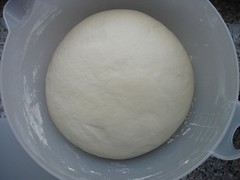
Cover the dough with plastic wrap, and allow to rise for an hour and fifteen minutes. Your dough should be a smooth, fat ball, like this:


On a floured surface, divide the dough into twelve equal pieces. Then roll each piece into a thin 18" snake, slightly fatter in the middle than at the ends. Twist each piece into a pretzel. Twist the ends as illustrated below, then attach the ends to the top of the arch to form a pretzel. If the dough is dry, use a drop of water to hold the ends in place.

Place each pretzel on parchment paper, cover with plastic wrap, and allow to rise for 15-20 minutes.


Preheat oven to 425 F (220 C).

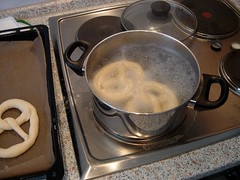
Combine baking soda with 4 cups water and bring to a boil. Dunk the pretzels one or two at a time for 30 seconds. Lay the pretzels on baking sheets lined with parchment paper. Sprinkle with coarse salt or sesame seeds while still wet. (About 1/4 teaspoon coarse salt per pretzel is enough. A little goes a long way.)


Bake the pretzels for 20 to 25 minutes until they are a dark golden brown. Serve fresh with butter, mustard, or cheese.


The Germans call pretzels Laugenbrezen, which means "lye pretzels." The secret to the distinctive crunchy exterior, it seems, is to dunk the dough in a 4% solution of NaOH (sodium hydroxide). For home use, baking soda is a suitable substitute, but using a lye solution is the right way to do it.

Make it stop

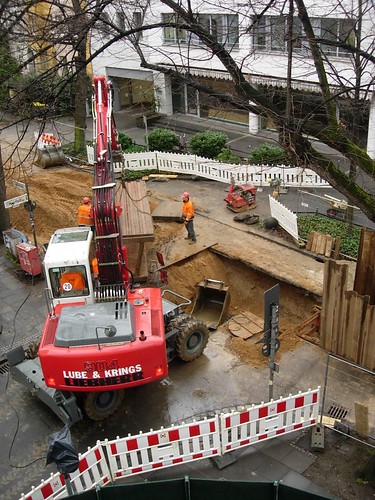
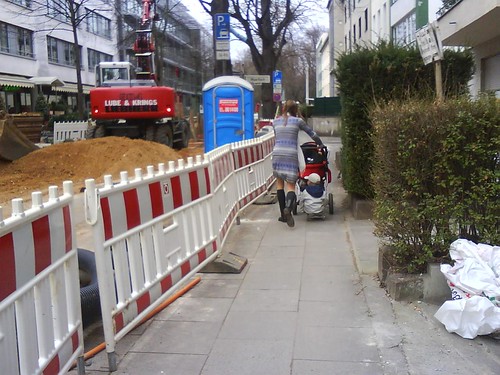
For as long as we have been in Bonn, our street has been torn up so workers can replace pipes. The project has crawled up the street, and is now in full force just outside our apartment. The booming and crashing begins every morning around 6:45 and goes on until the late afternoon. At the current pace of progress, they will be on our block until, oh, about the time we move again.


The project is popular with small children, as you can imagine. (Check out this little kid's sweet ride on the back of the stroller.)


As for me, two backhoes are outside my window making noise and shaking my floor, and I'm ready for it to end.

Eugene and Nikki were here


They came, they saw, they wandered.

Telltale signs that I may be living in a German apartment

If I need light in the hallway leading to my apartment, I need to press a button that turns the light on for just long enough to climb two flights of stairs. It's a good idea to have my cellphone handy to use as a night light in case I don't make it to my door before the light goes out.

That hallway is not heated.

When I enter my apartment I am standing in an enclosed entrance hall (Flur), where I take my shoes off and tuck them under the stairs. Because there are no closets in Germany, I hang my coat on a hook on the wall. From the Flur I can reach the bathroom, the kitchen (separated from th Flur by a door), and the living room (also separated from the Flur by a door).

To reach the table with my food, I must go through two doors. It is nice to be able to close the door to the kitchen, especially if there's something stinky in there.

My refrigerator is about a third the size of an American refrigerator. I do not have a freezer, which effectively deprives me of peas and ice cream. My fridge is designed to fit inside a kitchen cabinet (and my kitchen cabinets are designed to accommodate a fridge).

I heat my water to make my tea in an electric kettle. Mine happens to be cheap and poorly designed. Still, it boils water in about 60 seconds.

I carefully separate my trash: paper in one bin; glass in another; plastic and metal in a third. Many of the bottles I purchase can be returned to the grocery store, where I feed them into a machine, and get a little coupon that I redeem when I purchase my groceries. Because I separate out so many recyclables and Pfand bottles, it takes me a long time to accumulate actual trash. Unfortunately, this means a faint stink often lingers in the air.

I don't have any cookie sheets as such. I have a deep Backblech that came with my stove, and fits inside it like a baking rack. I am always puzzled that doesn't result in food that's over-baked either on the top or the bottom, but this is never the case.

I have an on-demand water heater in the kitchen, and another in the bathroom. This means that I have an infinite supply of hot water (though sometimes it isn't very hot).

My bathtub does not have a curtain. Nor does it have a door. It has a folding barrier that covers about two thirds of the width. Showers are chillier when you're not really enclosed.

I have a two-speed toilet. I explained how to operate a German toilet in a prior post.

I have a heated towel rack. (Be jealous.)

In my bathroom there is a washing machine. It is highly water-efficient. However, a cycle takes about two hours. It wants me to wash my clothes in really, really hot water, because that--so the thinking goes--is the secret to cleanliness.

90% of the stuff in my apartment came from Ikea: table, chairs, sideboard, hutch, TV stand, art, wardrobe, bed, bedding, rugs, lamps, dishes, pots, silverware, kitchen cabinets, etc.

Like my German neighbors, I am highly conscious of my electricity consumption. I turn lights off when I leave the room. I turn the television off--really off--when I'm not watching.

However, also like my German neighbors, I am not heat efficient. I participate in the great German ritual of lüften, which means that though there is a blizzard outside, I feel the need to open my windows and let all the warm air out, and the cold air in.

It may be that like my German neighbors, I am worried about Schimmel. Yes, mildew may be collecting even as I write this. Opening the window will save me from this fate. I guess.

My windows open in two directions. If the handle is horizontal, I can open my window like a door. If the handle is vertical, my window hinges at the bottom and opens a sizable crack at the top.

I do not have screens on my windows because I live in northern Europe, and there are few bugs to bug me. Also, if I had screens in my window, I would not be able to do any of those things with my windows. And if I didn't do those things with my windows, I might get Schimmel.

My doorknobs aren't knobs. They are horizontal. Thus:


My wife and I do not share a blanket. I have a small comforter with a duvet. She has the same.

Karneval Alaaf

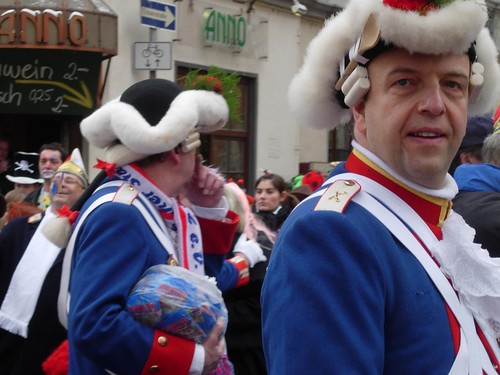
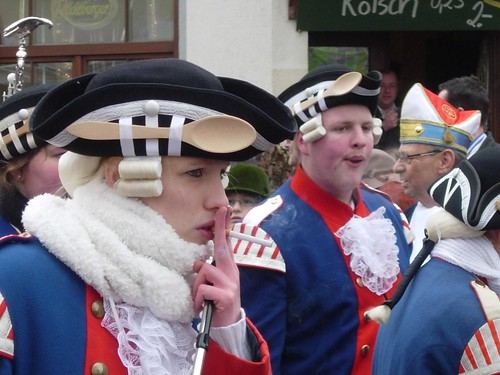
Like all of Rheinland, carnival is a major celebration in Bonn. There are dozens of events, of which the highlights are possibly Weiberfastnacht, when women snip off men's ties, carnival Sunday, when the old town hall is stormed by soldiers, and Rosenmontag (Rose Monday), when a parade winds through the city.

The gist of Rosenmontag is to wear a crazy costume and stand at the edge of the parade route...


Then as so-called regiments pass by...


... raise your arms and shout "Alaaf." Then the soldiers will throw you something good from their floats...


... such as Kamelle (candy) or Strüsschen (flowers).