Scenes from the Culture War, Continued


For more info, read coverage in ampelhead or Spiegel online.
Scenes from the Culture War
Berlin is a divided city: not a city divided between capitalists and communists, but instead a city divided between bohemians and yuppies. When the Berlin Wall fell, the eastern half of the city emptied out, and property was generally cheap. Artists, slackers, anarchists, and other bohemians filled in the void, and made the once-dreary east an increasingly area to live. And as everyone knows, once the starving artists make a neighborhood desirable, yuppies swoop in to buy property.
That’s exactly what’s happening in my Berlin neighborhood. Around the block from me on Schwedter Strasse, a gigantic, pricey, yuppie housing project known as Marthas Hof is going up.

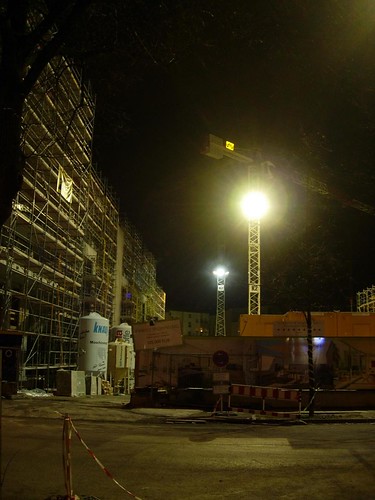
This does not sit well with the pre-existing bohemians. One Saturday, protesters gathered outside my building for a march protesting Marthas Hof.

Personally, I think the party’s nearly over, and Berlin is destined to become a more bourgeois place.
Here’s what’s strange: the people protesting Marthas Hof (and other signs of change such as the redevelopment of the vacant land where the Berlin Wall stood) are actually the social conservatives. They’re the ones who don’t want Berlin to change.Berlin / Berlin
That decision was gutsy: “West” Berlin was in decent physical condition, but “East” Berlin was decidedly shabby. I visited Berlin for a few days when I was a college junior studying in Vienna. The train dropped me off in the east (which, when you think about it, makes sense, since the shortest route from Vienna to Berlin is through formerly communist Czechoslovakia and the former East Germany). I only dimly remember the train station, but I recall the U-Bahn pedestrian tunnels as empty, smelly, and potentially dangerous. I retreated to West Berlin, and that’s the Berlin I recall.
I was with a couple of fellow students, and we had ventured east to the Brandenburg Gate, the place where symbolically the two Berlins met. It was dark, and it was time for dinner, and my recollection of wandering further east along Unter den Linden was that it was nearly abandoned. Finding a restaurant was a problem. In hindsight, what had happened was that when the border opened, there was an exodus to the west. It wasn’t until later that business reestablished itself in the east of the city.
So what that means is that West Berlin is the center of the reunified city, right? Wrong. From the vantage of 2009, I think the answer is actually that the physical, economic, and cultural center is now shifting decidedly into what was East Berlin. That area that seemed so desolate is now a top destination. And the West… well, there some nice areas, but the longer I live here, the more I think the former West is second tier.
Pop quiz. As you know by now if you’re a regular reader, I live within a stone’s throw of the old Berlin Wall. I took one of the following photos a few blocks west of my apartment in the former French Sector. I took the other photo a few blocks east of my apartment in what was once East Berlin. Which photo depicts the former East, and which depicts the former West?


The drab housing blocks are in the former west, in what strikes me as a working class neighborhood. The stately apartment building is in the former East, just off Kollwitzplatz, one of the most desirable addresses in all of Berlin. If you guessed incorrectly, you haven’t absorbed how much the Berlin urban landscape and social order has changed since reunification.
Since 1991 when the decision was made to move the capital, Berlin has experienced a non-stop construction boom. I don’t know the whole history, but I suspect the reconstruction of Berlin has happened in three overlapping phases.
- The first matter of business was getting government buildings ready. (The renovated Reichstag represents just the tip of the administrative building iceberg.) While the government was erecting workspaces, there was a flood of private redevelopment of vacant properties. (A good example is Potsdamer Platz. Previously an area destroyed in the war that had never been rebuilt, it’s now chock full of gleaming new buildings, albeit with a few gaps to fill in its toothy smile.)
- The second wave was probably to renovate the landmarks. (The eastern end of Unter den Linden, where there are a number of imposing historic facades, is still being renovated. The Museum Island is pretty much finished. The last big project outstanding is rebuilding a long-destroyed Prussian palace.)
- Enough of the city has been pasted back together that my sense is that construction has shifted into a third phase: the redevelopment of private residential property. Everywhere I look, scaffoldings cover old facades (renovation) and new facades (under construction).
Here’s a scene on my street.

The building on the right is the face of the once and future Berlin. I don’t know the history of the building on the left, but I would not be surprised to learn that the damage to the façade dates to WWII. I sense strong reluctance to repair the scars of war, but I think it’s just a matter of time until the building on the left gets a facelift.
As I see it, Berlin is building (and building and building) its way towards normalcy, but for this to happen, some adjustments will be necessary. The former west is going to play second fiddle. There’s a poetic justice to this, in that the former East Germans feel that reunification was really more like a takeover. The price of imposing a new order is ceding the center to the East (or if you rather, conceding that the East is the center).


Twenty years later